15 Best Things to Do in Siena, Italy: First-Timer Guide
The fifteen things worth your time in Siena, with 2026 ticket prices, the opening hours that catch visitors out, and what to skip.
In this guide
- Siena attractions at a glance
- 1. Begin in Piazza del Campo
- 2. Enter Palazzo Pubblico and the Museo Civico
- 3. Climb Torre del Mangia—only when it suits you
- 4. Give Siena Cathedral enough time
- 5. Step inside the Piccolomini Library
- 6. See the cathedral floor when it is uncovered
- 7. Visit Museo dell’Opera and the Facciatone
- 8. Add the Baptistery and Crypt
- 9. Cross Piazza del Duomo to Santa Maria della Scala
- 10. Wander through Siena’s 17 contrade
- 11. Walk to Basilica di San Domenico and the Sanctuary of Saint Catherine
- 12. Take a break at Orto de’ Pecci
- 13. Explore the Fortezza Medicea
- 14. Visit the Pinacoteca Nazionale if you love Sienese painting
- 15. Eat the food Siena is known for
- How to choose what to do in Siena
- Practical booking advice
- Final thoughts
- FAQ
Siena attractions at a glance
| Attraction | Best for | Suggested time | Booking advice | First-visit priority |
|---|---|---|---|---|
| Piazza del Campo | Every visitor | 30–60 minutes | No ticket needed | Essential |
| Palazzo Pubblico and Museo Civico | Art and civic history | 60–90 minutes | Booking can help | High |
| Torre del Mangia | Panoramic views | 45–75 minutes | Same-day ticket only | High if physically suitable |
| Siena Cathedral complex | Art and architecture | 2–3 hours | Book ahead in busy periods | Essential |
| Santa Maria della Scala | History and rainy-day sightseeing | 90–120 minutes | Optional advance booking | High with extra time |
| Contrade neighbourhoods | Atmosphere and local identity | Open-ended | No booking | Essential |
| Orto de’ Pecci | Families and a green break | 30–60 minutes | No booking | Optional |
| Basilica di San Domenico | Religious history | 30–45 minutes | Check service times | Optional |
| Pinacoteca Nazionale | Sienese painting | 60–90 minutes | Check current hours | Specialist |
| Sienese food experience | Local culture | 60–120 minutes | Reserve popular tables | Essential |
1. Begin in Piazza del Campo
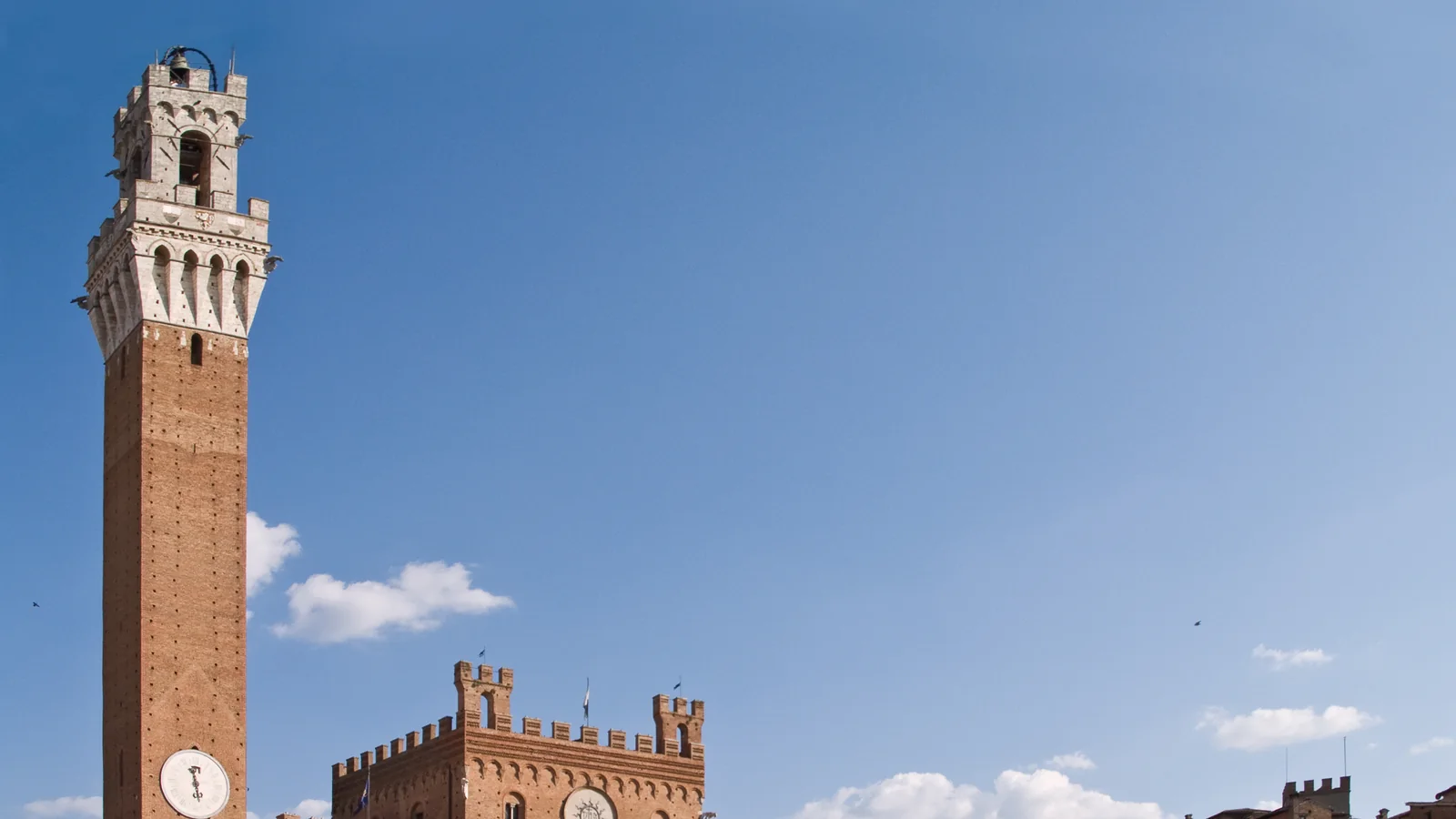
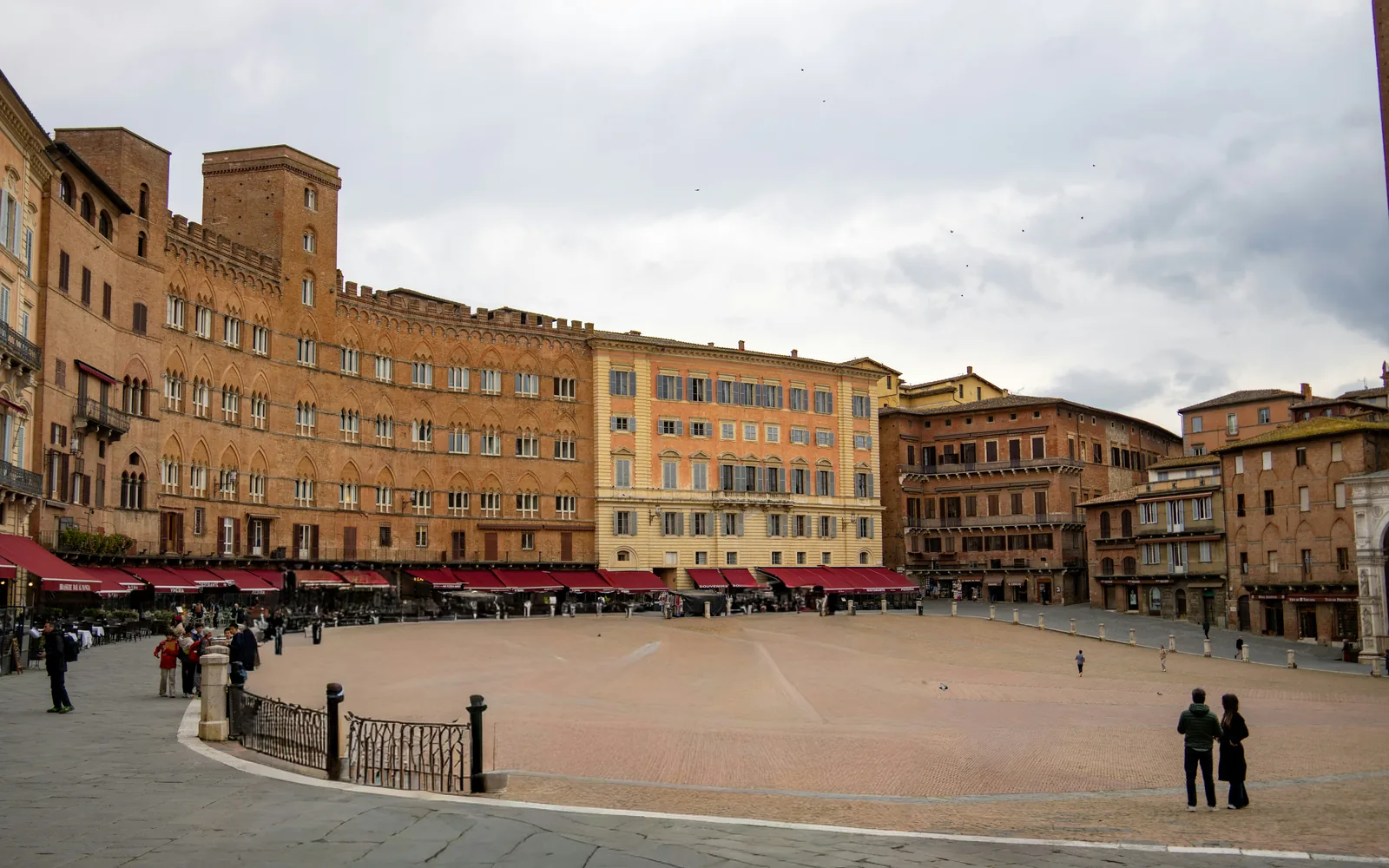
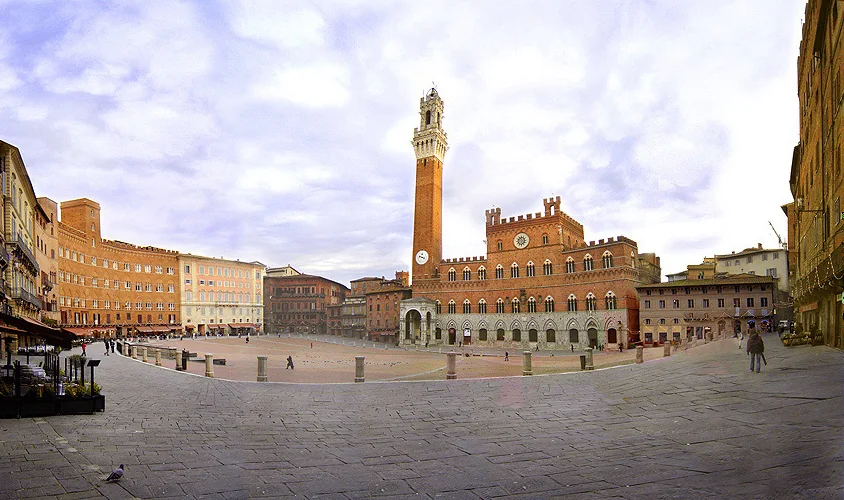
Piazza del Campo is Siena’s civic and social heart. Its sloping brick surface opens like a shell toward Palazzo Pubblico, with Torre del Mangia rising above the square.
The Campo is free to enter and deserves more than a quick photograph. Visit early when delivery carts and local commuters still shape the atmosphere, then return in the late afternoon when the brick buildings become warmer in the changing light.
Sitting at one of the café terraces costs more than ordering at a bar on a nearby street, but the view can be worth paying for once. Travellers watching their budget can simply sit on the square’s brick slope, as many visitors and residents do.
The Campo is also the setting for the Palio di Siena on July 2 and August 16. Preparations begin before race day, so barriers, crowds, ceremonies, and temporary opening-hour changes can affect a visit around those dates.
2. Enter Palazzo Pubblico and the Museo Civico
Palazzo Pubblico still functions as Siena’s town hall, but part of the building houses the Museo Civico. Its frescoed rooms are central to understanding the political identity of medieval Siena.
The museum is especially valuable for visitors interested in Ambrogio Lorenzetti’s cycle on good and bad government and Simone Martini’s *Maestà*. The art is not presented only as decoration; it reflects how the city understood power, responsibility, and public life.
As checked in July 2026, the museum’s standard full-price ticket is listed at €10 when purchased without advance reservation. Current exhibitions and ticket combinations may change, so confirm the official page before visiting.
Travelers who cannot or do not want to climb the tower can still enjoy Palazzo Pubblico through the museum. The official visitor information states that the museum route is on one level and that an elevator is available on request, although travellers should verify their own accessibility requirements directly.
3. Climb Torre del Mangia—only when it suits you
Torre del Mangia offers one of Siena’s most dramatic viewpoints, but the climb is physically demanding. Reaching the top involves about 400 steps through a narrow historic structure with no elevator.
Official July 2026 information lists departures at 45-minute intervals, limited to 25 people. Tickets that include the tower cannot be reserved in advance and are sold only on the day of the visit, subject to availability. The standard tower ticket is listed at €10; a Museo Civico and tower combination is listed at €15.
During the main March-to-October season, published hours are generally 10:00 to 19:00, with last admission at 18:15. Bad weather, maintenance, Palio operations, or safety decisions may close the tower without much notice.
Do not treat this climb as compulsory. It is strongly unsuitable for some visitors with mobility difficulties, vertigo, claustrophobia, heart or respiratory conditions, pregnancy, or other health concerns. The Facciatone in the cathedral complex provides another elevated view, although that route also includes stairs.
4. Give Siena Cathedral enough time
Siena Cathedral is not a sight to squeeze into a spare half hour. The black-and-white marble exterior is only the beginning; inside, visitors find striped columns, sculpture, paintings, an elaborate pulpit, and the city’s extraordinary marble inlay floor.
The cathedral remains an active place of worship, so sightseeing hours may change for services and special events. Respectful clothing and quiet behaviour are appropriate, and the final entry is normally before closing time.
The best-value choice for most first-time visitors is usually the OPA SI Pass rather than a cathedral-only ticket. It covers the main parts of the monumental complex and is valid for three consecutive days. Following the Opera's March 2026 restructure, and as re-checked on 16 August 2026, the pass is €13 during normal periods and €15 during the scheduled floor-uncovering periods. Our cathedral ticket guide sets out all three routes and the free winter window.
Book through the official ticket channel when you need a fixed entry plan. Third-party tours can add historical context, but they should not be presented as the only way to enter.
5. Step inside the Piccolomini Library
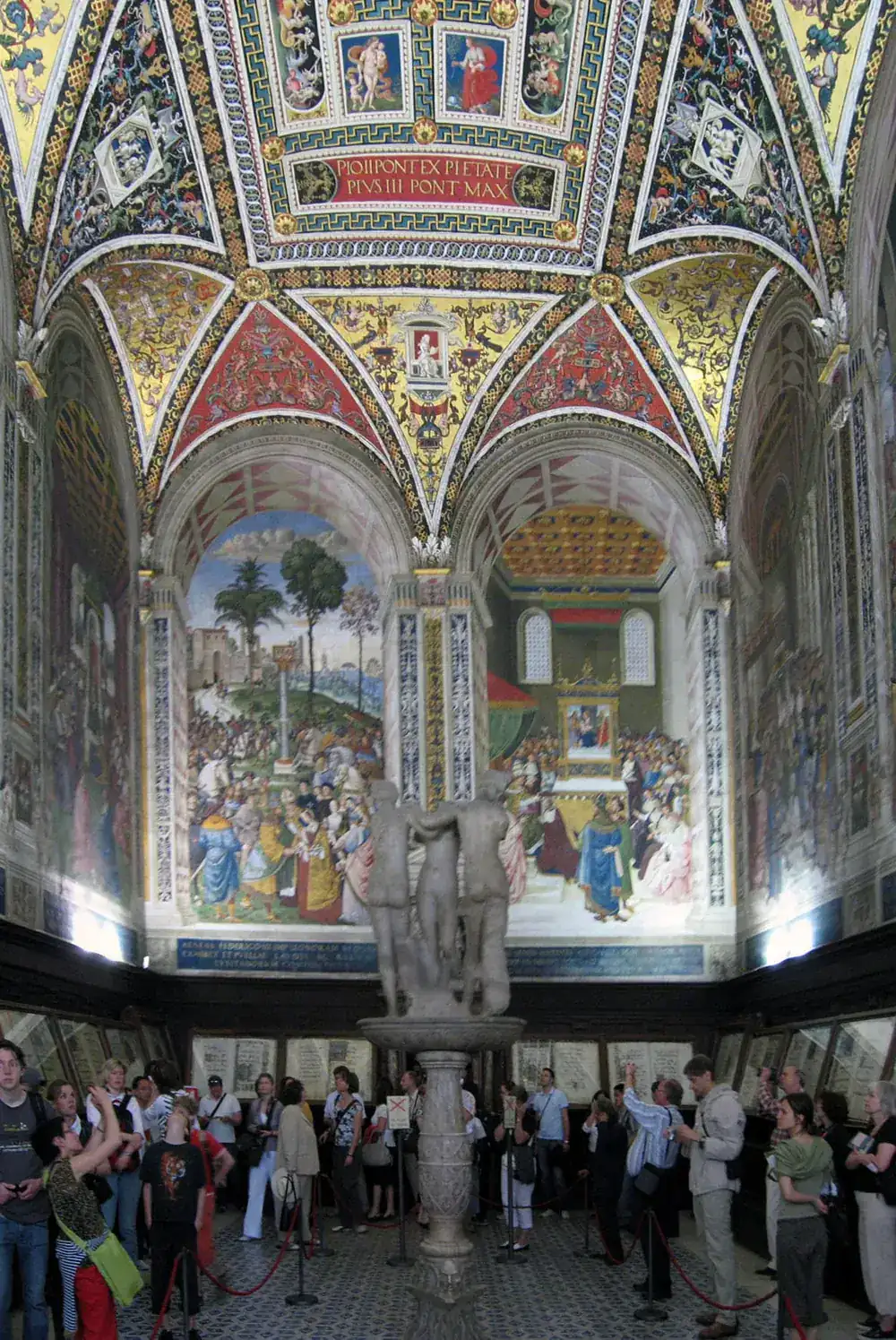
The Piccolomini Library sits inside the cathedral and offers a vivid contrast to the striped nave. Pinturicchio and his workshop created the fresco cycle, while the painted ceiling makes the room feel like a jewel box.
Because it is relatively small, some visitors pass through too quickly. Slow down long enough to follow the sequence around the walls and look upward. For many first-time visitors, this becomes one of the most memorable interiors in Siena.
Access is normally included in the relevant cathedral admission, but current ticket inclusions should be confirmed on the official Opera Duomo website.
6. See the cathedral floor when it is uncovered
The Duomo’s marble inlay floor is normally protected for conservation. In 2026, the official full-uncovering calendar lists June 27 to July 31 and August 18 to November 15.
During those periods, more of the floor is visible and demand can be higher. The cathedral remains worth visiting outside the uncovering dates, but travellers should not organise an entire trip around the floor without checking the official calendar first.
The OPA SI Pass costs €15 during the uncovering period, as re-checked on 16 August 2026. Child rates were restructured along with everything else in March 2026 and we could not confirm the current figures, so treat any child price you find elsewhere as unverified and ask at the ticket office.
7. Visit Museo dell’Opera and the Facciatone
Museo dell’Opera preserves works connected with the cathedral complex, including art that helps visitors understand the building beyond its architecture.
The route also leads toward the Facciatone, the large unfinished façade associated with Siena’s ambitious medieval cathedral expansion. From its elevated walkway, visitors can see the Duomo, Torre del Mangia, terracotta roofs, and the countryside beyond the city.
This is a strong alternative when Torre del Mangia tickets are unavailable or when you want your viewpoint included within a wider cathedral visit. Access remains narrow and stair-heavy, so it is not a fully accessible substitute.
8. Add the Baptistery and Crypt
The Baptistery and Crypt make the cathedral complex feel like a layered journey rather than a single church visit.
The Baptistery lies below the cathedral and contains its own sculptural and painted details. The Crypt preserves medieval wall painting in a more intimate setting. Neither needs to be the first priority on a rushed visit, but both are worthwhile when you have a half day for the complex or a multi-day OPA pass.
A practical order is cathedral and library first, then Museo dell’Opera and the viewpoint, followed by the Crypt or Baptistery if energy and time remain.
9. Cross Piazza del Duomo to Santa Maria della Scala
Santa Maria della Scala is a vast former hospital complex directly opposite the cathedral. It once cared for pilgrims, poor residents, abandoned children, and the sick; today it contains historic rooms, frescoes, archaeological collections, and changing exhibitions.
Its scale is easy to underestimate. A focused visit takes around 90 minutes, but visitors who enjoy history can spend much longer.
From March 15 to October 31, the official 2026 schedule lists daily opening from 10:00 to 19:00, with last admission at 18:15. The full-price ticket is listed at €9, or €8 with reservation. On July 2 and August 16 it closes earlier because of the Palio.
Santa Maria is particularly useful during rain, intense summer heat, or a second day in Siena. It is also more accessible than many medieval attractions: the official site lists elevators, accessible restrooms, seating, and a multilingual museum app.
10. Wander through Siena’s 17 contrade
Siena is divided into 17 contrade, historic districts with their own emblems, colours, fountains, traditions, and community life. The contrade are not decorative tourist themes created for the Palio; they remain living social institutions.
As you walk, notice animal symbols, flags, plaques, small fountains, and oratories. Move beyond the direct Campo-to-Duomo route and Siena becomes quieter: arches frame narrow lanes, laundry hangs above courtyards, and fragments of countryside appear between buildings.
Be respectful around private gatherings and contrada spaces. During the Palio season, neighbourhood activity becomes more intense, and visitors should avoid treating ceremonies or community meals as staged entertainment.
11. Walk to Basilica di San Domenico and the Sanctuary of Saint Catherine
Basilica di San Domenico is a large brick church closely connected with Saint Catherine of Siena. Its restrained architecture creates a different mood from the ornate cathedral.
The nearby Sanctuary of Saint Catherine develops around the area associated with her family home. Together, these sites add religious and historical context to the Fontebranda side of Siena.
This route is especially suitable on a second day or for visitors interested in pilgrimage. Churches may limit sightseeing during services, so check current access before making a special trip.
12. Take a break at Orto de’ Pecci
Orto de’ Pecci provides green space below the historic centre near Piazza del Mercato. It offers an unusual view back toward Siena’s medieval skyline and a welcome change from stone streets and museum interiors.
Families often appreciate the open space, while adults may simply enjoy a quiet pause. Remember that walking down is easier than returning uphill, so allow time and energy for the climb back.
This is not a replacement for Piazza del Campo or the Duomo on a short first visit. It is an excellent addition when you have a full day, are travelling with children, or want a slower afternoon.
13. Explore the Fortezza Medicea
The Fortezza Medicea sits near the edge of the historic centre. Its broad paths and green surroundings provide space for walking, exercising, or watching the light change over the city and nearby hills.
It works best at the end of a longer visit, near sunset, or when your accommodation is on the Camollia side of Siena. First-time day trippers should prioritise the Campo and Duomo, but overnight visitors may find the fortress a refreshing counterpoint to the dense medieval streets.
14. Visit the Pinacoteca Nazionale if you love Sienese painting
The Pinacoteca Nazionale contains an important collection of Sienese painting from the medieval and Renaissance periods. It is especially rewarding for travellers who want to understand how Siena’s artistic tradition differed from Florence’s.
This is a specialist recommendation rather than an automatic first-visit essential. The Museo Civico and cathedral complex are more immediately accessible for many travellers, while serious art lovers may consider the Pinacoteca indispensable.
Check its current opening schedule before visiting because state-museum hours can be more limited than those of Siena’s headline monuments.
15. Eat the food Siena is known for
A good Siena itinerary includes time to sit down. Look for pici all’aglione, pici with breadcrumbs, ribollita, crostini neri, wild-boar ragù, Cinta Senese products, local pecorino, and seasonal Tuscan dishes.
Leave room for sweets. Ricciarelli are soft almond biscuits, while panforte is a dense spiced fruit-and-nut confection strongly associated with Siena.
Piazza del Campo offers one of Italy’s most memorable dining settings, but the location is reflected in the bill. Travellers who prioritise value or food quality should compare menus on Via di Città, Via Banchi di Sopra, and the surrounding side streets rather than choosing the first terrace they see.
How to choose what to do in Siena
With one day
Prioritize Piazza del Campo, the Duomo complex, one viewpoint, lunch, and a contrada walk. Use our Siena 2-day itinerary only as inspiration for optional additions; do not try to compress both days into one.
With two days
Add Santa Maria della Scala, San Domenico and Fontebranda, Orto de’ Pecci, and a slower evening. See the complete Siena 2-day itinerary.
With three days
Spend two days exploring the city and use the third for either deeper Siena sightseeing or one carefully chosen Tuscan day trip. Read our Siena 3-day itinerary.
When travelling with children
Reduce the number of indoor attractions, plan shade and snack breaks, and use open spaces such as Orto de’ Pecci or the fortress. Our Siena with kids guide includes age-based planning advice.
Practical booking advice
Official attraction websites should be your primary source for opening hours, worship schedules, accessibility, and ticket rules. Use commercial platforms when they solve a real planning problem—such as comparing guided walks, food tours, or multi-stop Tuscany excursions—not as a substitute for official information.
For an overnight stay, choose the area before choosing the hotel. Central rooms put you closest to the main sights but may involve steps, noise, and difficult luggage access. Accommodation near Porta Camollia or the station can be more practical. Compare the trade-offs in Where to stay in Siena.
Travelers arriving from Florence should compare the bus’s central arrival with the train station’s uphill connection before booking. Read Florence to Siena by train or bus.
Final thoughts
The best things to do in Siena are not simply the attractions with the longest queues. The city becomes memorable when the Campo, the cathedral, a quiet contrada lane, and a long lunch are allowed to connect.
Come for the striped marble and medieval skyline, but leave space for the moments that cannot be scheduled: morning footsteps echoing under an arch, flags moving above a narrow street, the countryside appearing beyond the rooftops, and the Campo turning golden near the end of the day. That is usually the moment visitors stop treating Siena as a side trip—and start imagining when they can return.
Helpful summary
The short version
The fifteen things worth your time in Siena, with 2026 ticket prices, the opening hours that catch visitors out, and what to skip.
Frequently asked
FAQ
Keep reading
Siena Tours and Classes: What to Book First
Which Siena tours to book ahead and which can wait until the day — walking tours, Duomo visits, cooking classes and wine trips compared.
10 min read · Updated 2026-07-12
The Bottini: Siena’s Underground Aqueduct and the River That Never Was
Siena’s bottini: the 25km medieval aqueduct under the city — what it is, the phantom river it replaced, and how visits actually work.
6 min read · Updated 2026-08-18
Quantum of Solace in Siena: The Filming Locations, Scene by Scene
Where Quantum of Solace was really filmed in Siena: the real 2007 Palio footage, the rooftop chase, what was a studio set and a 90-minute route.
11 min read · Updated 2026-08-17